Walmart Labs
Chase Pay inside Walmart Pay
Walmart Pay: adding Chase Pay to the wallet after Savings Catcher retired. A partner integration that arrived as a finished formula, taken to a store test that broke it.
Impact
- +18%
- Walmart Pay monthly active users in the six months after launch
- 34%
- Of Chase cardholders setting up Walmart Pay linked Chase Pay
- 2.1x
- Repeat Walmart Pay use among customers who linked Chase Pay
Outcome
Case snapshot
The situation
Savings Catcher retired on 14 May 2019, and Walmart Pay went with it.
"Save Money. Live Better." is Walmart's slogan, and Savings Catcher was the literal version of it: scan a receipt, and if a competitor advertised the item cheaper, get the difference back. It was also the reason a lot of people opened the Walmart app at the register at all. It was discontinued on 14 May 2019.
Walmart Pay lost the habit that had been carrying it. Without the price-matching payoff, paying in-app was slower than pulling out a card and offered nothing in return — so people stopped. Chase Pay was the answer on the table: a card issuer's own rewards, redeemable inside a wallet the customer had already set up, with no second app to learn.
The discontinuation of Savings Catcher caused a major decline in Walmart Pay's adoption and continued use.
What the work had to do
Give people more ways to save
Chase Ultimate Rewards points, redeemable as a statement credit at a Walmart register — a reason to reach for the app instead of the card.
Keep it convenient
The saving had to arrive without adding a second wallet to set up or a second thing to think about at the till.
Move adoption and retention
Not just first-time linking. The measure was whether people kept paying with Walmart Pay after the novelty.
My scope
The product designer on Walmart Pay, negotiating across two companies.
- What I owned
- The Chase Pay integration end to end, from June 2019 to April 2020 — the entry points, the value proposition wherever it appeared, the linking flow and its redirect out to Chase, the settings surface, and pay-with-points at the register. I was the only designer on it.
- The team
- Inside Walmart Pay: 1 design manager, 1 user researcher, 1 product manager and 10+ engineers. The researcher ran recruiting and the study script; the design manager ran critique. The design work was mine.
- Across the table
- 5 stakeholders at JPMorgan Chase. Every screen carrying Chase brand, Chase card data or Chase rewards language went through them, and I worked with them on legal review during the design, not after it.
- How the work was judged
- Walmart Pay adoption and retention, and whether it shipped on both platforms. It launched in the Walmart iOS app on 27 February 2020 and on Android on 4 June 2020.
The hard call
The integration arrived as a finished formula. I took it to a store floor anyway.
By the June 2019 kickoff, Chase had already shipped this integration several times over — with PayPal, with Samsung Pay, with merchants including Starbucks. There was a pattern, it worked, and it came with a partner who had every reason to want it applied as-is.
That is genuinely good news and genuinely bad news. I did not have to start from a blank page. But the design was nearly a ready-to-go formula, which left very little room for exploration — and a formula proven inside other companies' apps is not the same as a formula proven inside ours, next to a Walmart register, for a customer who has never heard of Chase Pay.
So instead of applying it, I spent seven weeks on iterations, critiques and prototyping, and we put it in front of twelve real Walmart-and-Chase customers in a store in Dallas. The study broke the formula in two places, both of which would have shipped invisibly.
What the store test found
The benefit was invisible
It was not evident that Chase Pay would save anyone time. Every participant had a Chase login, but most had never used Chase Pay — so they assumed linking it meant extra work somewhere outside the Walmart Pay setup they were already doing.
Linking all cards read as a risk
Participants could not tell the difference between adding a regular credit or debit card and linking Chase Pay. Pulling in every card at once felt convenient and alarming at the same time: they worried about spending a card, or rewards, they had not intended to.
In a household with shared account access, one wrong charge could be disastrous — and they would never use Walmart Pay again.
That second finding is the one that justified the whole detour. A convenience feature was reading as a way to lose control of your money, and the fix was cheap once we knew — but nothing in a ready-to-go formula was going to surface it.
How the work got made
Seven weeks of iteration in two offices, then a week on a store floor in a third.
Design and recruiting ran in parallel
Six weeks of design sprints and mockups in Sketch, then a week prototyping in Adobe XD. While that ran, the researcher spent two weeks recruiting participants and a week on pilot testing and the study script — so the prototype and the study were ready in the same fortnight rather than in sequence.
Legal review inside the design, not after it
I worked with the Chase partners on legal review during the seven weeks. On a two-company integration the rewards language and the data-handling claims are design material — finding out in month three which sentences are allowed means redrawing the screens they sit on.
Tested where the product actually lives
A week of in-store testing in Dallas: twelve Walmart and Chase customers, 60-minute one-on-one interviews, six on iOS and six on Android. The script deliberately went wider than the feature — their history of shopping at Walmart, and how they already used credit cards and digital payments — before touching the prototype.
Product designerMe
Design managerSan Bruno, CA
User researcherSeattle, WA
In the storeDallas, TX
- 12
- Walmart + Chase customers
- 60 min
- One-on-one, in the store
- 6 + 6
- iOS and Android
The study asked two questions and nothing else: can customers actually link Chase Pay to Walmart Pay and pay with points, and do they understand what linking it gets them. The second one is where it fell down.
- Account › Payment methods, or the Services tab
- Walmart Pay onboarding
- Choose a payment typeChase Pay entry
- Chase Pay benefits
- Leaving Walmart, back shortly
Outside Walmart
- Sign in, Chase Pay app
- Touch ID / Face ID
- Complete setup, back to Walmart
If the app isn't on the phone
- No Chase Pay app: sign in at chase.com in the browser
- Choose a default cardPay with points
- Create a Walmart PIN
- Scan the QR at the registerPoints on or off
- Payment confirmationChase Pay used
- Walmart Pay screen
- New Chase Pay screen
- Overlay
The craft
Three moves, all of them cheap to build.
The constraint on the fixes was the same one that had shaped the project: this was a partner integration late in its life, not a rebuild. So I worked in three registers that cost engineering almost nothing — adding visuals, changing the content layout, and choosing the words deliberately. Low technical effort, faster to scan, and they moved the things the study said were broken.
The other constant was that Chase Pay had to weave in and stand out at the same time. It belongs in the pack of payment options, or it reads as a separate product to learn. It also has to be distinguishable from a normal card during setup and every time you use it, or you get the security problem the study surfaced.
Answer "extra work" where Chase Pay is offered
Choose a payment type
- Credit or debit card
- Walmart gift card
- Chase Pay®Pay securely and use Ultimate Rewards® Points at checkout with eligible Chase Visa® cards.
Choose a payment type
- Credit or debit card
- Walmart gift card
- Chase Pay®Pay securely and use Ultimate Rewards® Points at checkout with eligible Chase Visa® cards. Just sign in once with Chase.
Name the benefit, not the brand
Pay
Benefits of linking Chase Pay®
- Link all your personal Chase Visa cards at once.
- Your linked cards will automatically stay updated.
- Redeem Ultimate Rewards® Points for a statement credit on qualifying purchases with an eligible card.
By linking Chase Pay®, you agree to Walmart's terms & conditions for using your rewards.
Pay
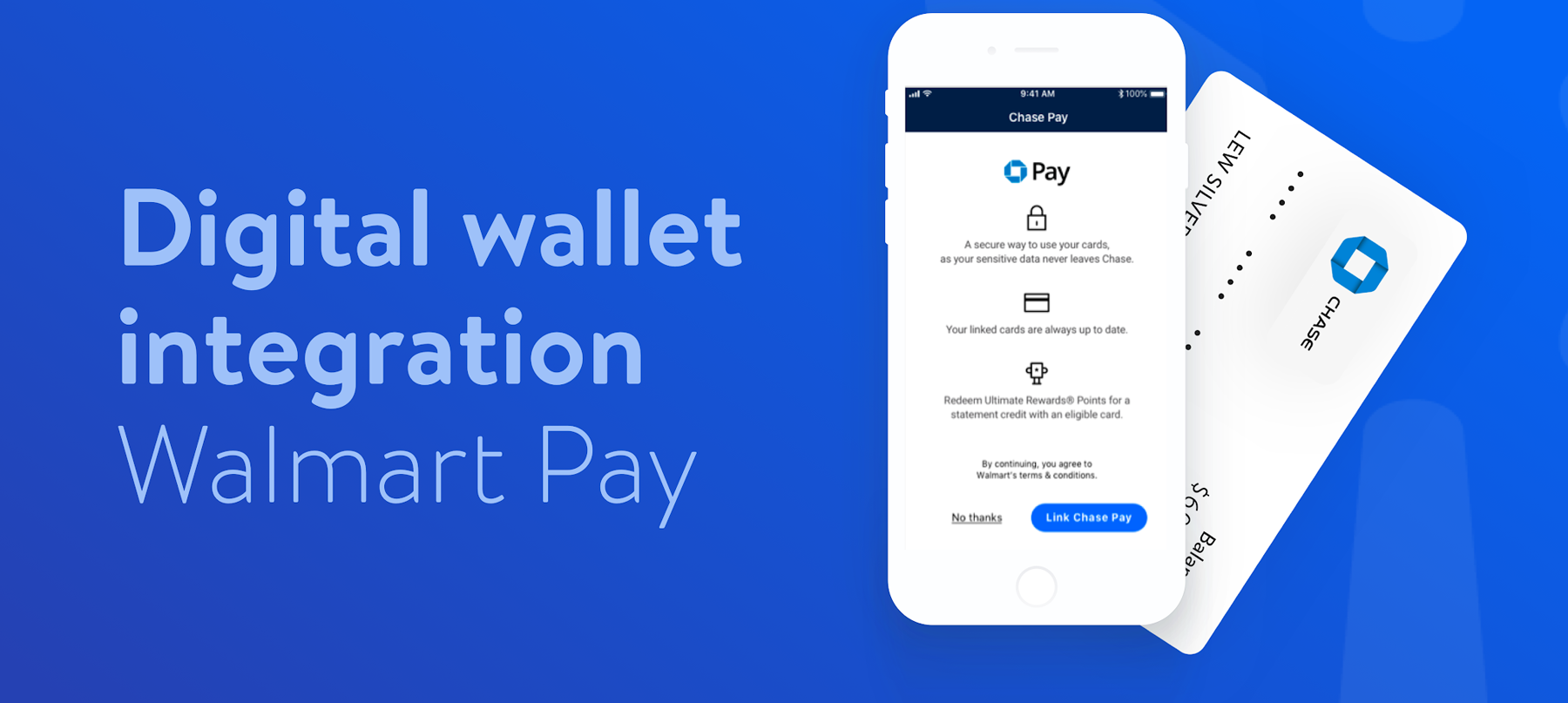
- A secure way to use your cards, as your sensitive data never leaves Chase.
- Your linked cards are always up to date.
- Redeem Ultimate Rewards® Points for a statement credit with an eligible card.
By continuing, you agree to Walmart's terms & conditions.
Chase Pay gets its own group
In settings, linked Chase cards sit in a separate group from credit and debit cards, under a line explaining that a secure token authorises payment and the sensitive data never leaves Chase. Participants had not been able to tell the two apart; separating them is what makes "I linked an account" different from "I added a card."
Say where the data actually lives
The security claim is specific rather than reassuring in general — your sensitive data never leaves Chase, your linked cards stay up to date. The study was clear that perceived security problems kill a payment feature just as dead as real ones.
Points off by default, in both currencies
The rewards toggle ships Off. Participants had accrued those points carefully and wanted to choose the moment to spend them, and the On/Off label next to the toggle makes the current state readable at a glance. The balance shows as both points and dollars — 1,232 points ($10.56) — because the conversion is not one-to-one and nobody should be doing that arithmetic at a register.
A linked account sits apart from a card
Credit and Debit Cards
Select your default payment method for Walmart Pay.
Ultimate Rewards® Points: OffOn
1,232 points available ($10.56)Use 1,232 points ($10.56)
Turn on to pay with Ultimate Rewards® Points for a statement credit.Your card will be charged for the full amount. Chase will apply a statement credit for any available points used.
Payment Methods for Walmart Pay
Credit and debit cards
Chase PayUnlink
We use a secure token to authorize payment. Your sensitive data never leaves Chase.
Ultimate Rewards® Points: OffOn
1,232 points available ($10.56)Use 1,232 points ($10.56)
Turn on to pay with Ultimate Rewards® Points for a statement credit.Your card will be charged for the full amount. Chase will apply a statement credit for any available points used.
The last one is the smallest and my favourite. Participants liked being warned before the app redirected them out to Chase — it made linking two systems feel deliberate rather than like something slipping out of their hands. But the alert only said they were leaving Walmart. It never said they were coming back.
So after a lot of iterations the copy gained "briefly" and "shortly", and the passive voice went active: not "you will be redirected", but we will direct you to Chase and return you here. Same alert, same engineering, and it now reads as Walmart taking care of you rather than Walmart handing you off.
The alert promises the way back
Pay
Benefits of linking Chase Pay®
- Link all your personal Chase Visa cards at once.
- Your linked cards will automatically stay updated.
- Redeem Ultimate Rewards® Points for a statement credit on qualifying purchases with an eligible card.
By linking Chase Pay®, you agree to Walmart's terms & conditions for using your rewards.
You're now leaving Walmart
You will be redirected to Chase mobile app or website.
CancelOK
Pay
- A secure way to use your cards, as your sensitive data never leaves Chase.
- Your linked cards are always up to date.
- Redeem Ultimate Rewards® Points for a statement credit with an eligible card.
By continuing, you agree to Walmart's terms & conditions.
You're briefly leaving Walmart
We'll direct you to the Chase app or website to sign in, and return you here shortly.
CancelOK
The points state follows you to the register
Payment Methods for Walmart Pay
Credit and debit cards
Chase PayUnlink
We use a secure token to authorize payment. Your sensitive data never leaves Chase.
Ultimate Rewards® Points: OffOn
1,232 points available ($10.56)Use 1,232 points ($10.56)
Turn on to pay with Ultimate Rewards® Points for a statement credit.Your card will be charged for the full amount. Chase will apply a statement credit for any available points used.
Scan Walmart Pay QR code at register
Paying with this card
Impact
Shipped on both platforms, and Walmart Pay use came back.
Outcome
- +18%
- Walmart Pay monthly active users in the six months after launch
- 34%
- Of Chase cardholders setting up Walmart Pay linked Chase Pay
- 2.1x
- Repeat Walmart Pay use among customers who linked Chase Pay
Shipped
- 27 Feb 2020
- Launched in the Walmart iOS app
- 4 Jun 2020
- Launched in the Walmart Android app
- 2
- Platforms, one design, three months apart
Research and process
- 12
- Walmart and Chase customers, 60-minute sessions in-store
- 7 wks
- Iteration, critique and prototyping before the study
- 5
- JPMorgan Chase stakeholders worked with directly
What the study settled, beyond this feature
Security, security, security
People want their money safely spent, and they read safety off the interface. Real and perceived security problems are a deal-killer at any stage of a payment flow — which means the reassurance is product work, not copy applied at the end.
Another way to pay is not a benefit
Merely adding a payment option does not move adoption. Customers need a benefit big enough to be worth changing a habit at a register, and saving time and effort is where that starts.
Money, time, effort, security
Everything the study surfaced, good or bad, came back to one of those four. Monetary incentive is what triggers action; the other three are what stop it.
What I'd do differently
Two things I found late that were findable early.
I let the value proposition assume familiarity
Every participant had a Chase login and almost none had used Chase Pay. That was knowable before the study — it is a fact about the customer base, not a finding — and the first design still leaned on the Chase brand carrying its own meaning. Naming the actual benefit at every entry point should have been the starting position, not the correction.
I fixed the reassurance, then had to go back for the timing
The redirect alert made people feel safer, and I took the positive signal at face value for too long. It was only after many iterations that I noticed it never promised the trip to Chase was momentary. Reading the alert against the anxiety it was supposed to answer, rather than against whether people liked it, would have caught that in one pass.
I would have taken the formula to customers in week one
The store test came after seven weeks of design. A rough version of Chase's ready-made pattern in front of a handful of customers at the start would have surfaced both findings before the screens were drawn, and turned the weeks of iteration into weeks of fixing the right things.
For the detailed case study, reach out to me (opens Gmail in a new tab).